
Summer Reading 2024
Read along with current students
Check out the summer reading assignment for this year’s incoming class and participate in thought-provoking reads designed to introduce first-year students to Duke’s academic climate and encourage intellectual dialogue.

A Life of Adventure and Delight
Akhil Sharma, Adele Schiff Professor of the Practice of English
A Life of Adventure and Delight delivers eight masterful stories from dazzlingly original and critically acclaimed author Akhil Sharma.
Hailed as a storyteller whose fiction is “a glowing work of art” (Wall Street Journal), Akhil Sharma is possessed of a narrative voice “as hypnotic as those found in the pages of Dostoyevsky” (The Nation). In A Life of Adventure and Delight, Sharma delivers eight masterful stories that focus on Indian protagonists at home and abroad and that plunge the reader into the unpredictable workings of the human heart. A young woman in an arranged marriage awakens one day surprised to find herself in love with her husband. A retired divorcé tries to become the perfect partner by reading women’s magazines. A man’s longstanding contempt for his cousin suddenly shifts inward when he witnesses his cousin caring for a sick woman. Tender and darkly comic, the protagonists in A Life of Adventure and Delight deceive themselves and engage in odd behaviors as they navigate how to be good, how to make meaningful relationships, and the strengths and pitfalls of self-interest. Elegantly written and emotionally immediate, the stories provide an intimate, honest assessment of human relationships between mothers and sons, sons and lovers, and husband and wives from a dazzlingly original, critically acclaimed writer.
5 Questions to Consider While Reading
- Akhil Sharma’s stories appear concerned with the transformative power of love. But is that a fair interpretation, or would it be more accurate that they are concerned with a desire for transformation?
- The stories almost always involve characters striving for something and when achieving it realizing that reality is more complicated than fantasy. To what extent is the complicated nature of reality hopeful instead of merely challenging?
- A Life of Adventure and Delight involves a character who grew up in a traumatic background. If we paid more attention to the mention of widow burning does his desire to avoid relationships make more sense?
- Mr. Sharma has said that he is primarily interested in keeping the subject of each sentence in the first third of the sentence, that he likes to combine sentences when he wants the visuals to become smudged. What are some of the techniques that you spot him repeatedly using?
- Writing about a minority community involves trying to explain that community to readers who belong to the majority community. An author who is interested in maintaining suspension of disbelief needs to hide this explaining. What are the different ways Mr. Sharma explains or doesn’t explain the Indian community?
Biography
Akhil Sharma is a novelist and short story writer. He came to America when he was eight and grew up primarily in New Jersey and New York. He says that for him, human being are not thinking creatures, but creatures who feel and who also happen to think. The short stories in his collection A Life of Adventure and Delight contain stories from the full length of his career. Cosmopolitan and If You Sing Like That For Me were written when he was nineteen and twenty. A Life of Adventure and Delight was written when he was forty-six.

On the Swamp: Fighting for Indigenous Environmental Justice
Ryan Emanuel '99, Associate Professor of Hydrology
Despite centuries of colonialism, Indigenous peoples still occupy parts of their ancestral homelands in what is now Eastern North Carolina—a patchwork quilt of forested swamps, sandy plains, and blackwater streams that spreads across the Coastal Plain between the Fall Line and the Atlantic Ocean. In these backwaters, Lumbees and other American Indians have adapted to a radically transformed world while maintaining vibrant cultures and powerful connections to land and water. Like many Indigenous communities worldwide,they continue to assert their rights to self-determination by resisting legacies of colonialism and the continued transformation of their homelands through pollution, unsustainable development, and climate change.
Environmental scientist Ryan E. Emanuel, a member of the Lumbee tribe, shares stories from North Carolina about Indigenous survival and resilience in the face of radical environmental changes. Addressing issues from the loss of wetlands to the arrival of gas pipelines, these stories connect the dots between historic patterns of Indigenous oppression and present-day efforts to promote environmental justice and Indigenous rights on the swamp. Emanuel’s scientific insight and deeply personal connections to his home blend together in a book that is both a heartfelt and an analytical call to acknowledge and protect sacred places.
5 Questions to Consider While Reading
- What do you think time immemorial means to Indigenous peoples, and how did this book influence your own thinking about time and history?
- What do you think it means to apply an “Indigenous lens” to questions of environmental justice – including questions around the uneven impacts of pollution and climate change, questions around sustainable use of resources, or questions around barriers to the participation of marginalized groups in environmental decision making?
- In his 1969 book Custer Died for Your Sins, Vine Deloria Jr. declared, “Mythical generalities of what built this country and made it great must now give way to consideration of keeping contractual obligations due to the Indian people.” What are some of the myths that continue to affect environmental decision making (or environmental thinking more generally), and why do these myths persist in the 21st century?
- Not all Native American Tribes in the United States have formal recognition from the federal government. How can the lack of federal recognition limit the ability of Tribes to care for their homelands, and what are some steps that Tribes in North Carolina (or elsewhere) have taken to overcome these limitations?
- How does this book prepare you to take action in your own community (or in other spaces that you occupy)?
Biography
Ryan Emanuel is an associate professor of hydrology in the Nicholas School of the Environment and an enrolled citizen of the Lumbee Tribe of North Carolina. He studies impacts of climate change, pollution, and unsustainable development on water, ecosystems, and people. He also partners with Indigenous communities on a variety of research, education, and outreach projects. Besides his book, On the Swamp, Emanuel has published more than fifty research articles in academic journals across the natural sciences, social sciences, and humanities. Before joining Duke in 2022, Emanuel was a professor at North Carolina State University where he was also recognized as a University Faculty Scholar and an Alumni Association Distinguished Graduate Professor. He was a 2020-2021 Fellow at the National Humanities Center and was a member of the 2020-2022 class of the William C. Friday Fellowship for Human Relations. Emanuel attended public schools in Charlotte, North Carolina is a proud Duke grad.

Shae
Mesha Maren, Associate Professor of the Practice of English
When sixteen-year-old Shae meets Cam, who is new to their small town in West Virginia, she thinks she has found someone who is everything she has ever wanted in a companion. The two become fast friends, and then more. And when Shae ends up pregnant, Cam begins a different transition—trying on clothes that Shae can no longer fit into and using female pronouns. Shae tries to be fully supportive as Cam becomes the person she wants and needs to be.After a traumatic C-section and the birth of their daughter, Eva, Shae is given opioids to manage the intense pain. During the first year of Eva’s life, Shae’s dependence shifts from pain management to addiction, and her days begin to revolve around getting more pills. In the heart of West Virginia, opioids are dispensed as freely as candy, and Shae is just one of many to fall victim to addiction. Meanwhile, as Cam continues to transition, she embraces new relationships and faces the reality of being a trans woman in rural America.Shae is as much about these two young women as it is about the home they both love despite its limitations. Following the acclaimed Sugar Run and Perpetual West, this is Mesha Maren’s most intense and intimate novel yet.
5 Questions to Consider While Reading
- Shae revolves around not one but two important issues in contemporary American life: the opioid crisis and its impact on small communities, particularly in Appalachia, and the battles surrounding transgender rights. Have either of these issues touched your life or the lives of people you know?
- Shae is described as being “as much about these two young women as it is about the home they both love despite its limitations.” Do you relate to loving a place despite its limitations? What roles do the geography and culture of the place where you were raised play in your life?
- Shae is a love story but it complicates the notions of both maternal and romantic love by empathetically portraying two young women dealing with the fallout of the opioid crisis. This novel prompts questions about how pain and addiction can ripple through multiple generations.
- Shae’s mother, Donna, is a loving and supportive character throughout the novel. She also attempts to ignore the fact that Cam is transitioning right under her nose. Can we truly love and support someone even if we do not entirely understand what they are going through?
- The novel opens with Shae trying to reconcile the fact that she and her partner Cam do not agree on their first memories of one another. What role do shared memories play in your relationships?
Biography
Mesha Maren is the author of the novels Sugar Run, Perpetual West, and Shae (May 2024, Algonquin Books). Her short stories and essays can be read in Tin House, The Oxford American, The Guardian, Crazyhorse, Triquarterly, The Southern Review, Ecotone, Sou’wester, Hobart, Forty Stories: New Writing from Harper Perennial, and elsewhere. She was the recipient of the 2015 Thomas Wolfe Fiction Prize, a 2014 Elizabeth George Foundation grant, an Appalachian Writing Fellowship from Lincoln Memorial University, and fellowships from the MacDowell Colony and the Ucross Foundation. She was the 2018-2019 Kenan Visiting Writer at the University of North Carolina at Chapel Hill. She is an Associate Professor of the Practice of English at Duke University.

The Accidental Equalizer: How Luck Determines Pay after College
Jessi Streib, Associate Professor of Sociology
A startling discovery—that job market success after college is largely random—forces a reappraisal of education, opportunity, and the American dream.
As a gateway to economic opportunity, a college degree is viewed by many as America’s great equalizer. And it’s true: wealthier, more connected, and seemingly better-qualified students earn exactly the same pay as their less privileged peers. Yet, the reasons why may have little to do with bootstraps or self-improvement—it might just be dumb luck. That’s what sociologist Jessi Streib proposes in The Accidental Equalizer, a conclusion she reaches after interviewing dozens of hiring agents and job-seeking graduates.
Streib finds that luck shapes the hiring process from start to finish in a way that limits class privilege in the job market. Employers hide information about how to get ahead and force students to guess which jobs pay the most and how best to obtain them. Without clear routes to success, graduates from all class backgrounds face the same odds at high pay. The Accidental Equalizer is a frank appraisal of how this “luckocracy” works and its implications for the future of higher education and the middle class. Although this system is far from eliminating American inequality, Streib shows that it may just be the best opportunity structure we have—for better and for worse.
5 Questions to Consider While Reading
- How did you find your first job after college? Do you think luck was involved in the pay you received?
- Thinking about times you have hired other people or been hired yourself, what do you think is the best process? Should candidates have more information about what hiring agents are looking for, how the interview process will go, the job, and the pay? Have you observed hiring processes that have been class-neutral?
- Do you think your class background has shaped how you applied for jobs or whether you’ve been hired? Why/why not? Do you think your class background shapes how you go about other parts of your life?
- There’s a trade-off: we can have a system that allows students from unequal class backgrounds to receive equal earnings, or we can have transparency in the hiring process and pay. Which do you prefer? Why?
- Are there other ways you think we can create more equal opportunities for people born into different social classes?
Biography
Jessi Streib is an Associate Professor of Sociology at Duke University and the co-recipient of the 2023 Early Career Award from the Inequality, Poverty, and Mobility section of the American Sociological Association. Her work focuses on how people stay in or move out of their childhood class position and how class, gender, and racial inequalities are maintained and challenged. She is the author of The Power of the Past: Understanding Cross-Class Marriages, Privilege Lost: Who Leaves the Upper Middle Class and How They Fall, and the #1 new release in sociology: The Accidental Equalizer: How Luck Determines Pay After College. She is also the co-author of the forthcoming book, Is it Racist? Is it Sexist? Why Red and Blue White People Disagree, and How to Decide in the Gray Areas.
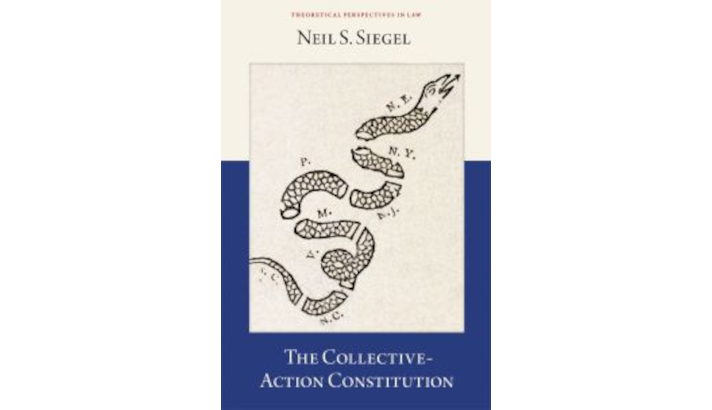
The Collective-Action Constitution
The United States Constitution was established primarily because of the widely recognized failures of its predecessor, the Articles of Confederation, to adequately address "collective-action problems" facing the states. These problems included funding the national government, regulating foreign and interstate commerce, and defending the nation from attack. Meeting such challenges required the states to cooperate or coordinate their behavior, but they often struggled to do so both inside and outside the Confederation Congress. By empowering Congress to solve collective-action problems, and by creating a national executive and judiciary to enforce federal law, the Constitution promised a substantially more effective federal government.
An important read for scholars, lawyers, judges, and students alike, Neil Siegel's The Collective-Action Constitution addresses how the U.S. Constitution is, in a fundamental sense, the Collective-Action Constitution. Any faithful account of what the Constitution is for and how it should be interpreted must include the primary structural purpose of empowering the federal government to solve collective-action problems for the states and preventing them from causing such problems. This book offers a thorough examination of the collective-action principles animating the structure of the Constitution and how they should be applied to meet many of the most daunting challenges facing American society today.
5 Questions to Consider While Reading
- What is the main argument of the book?
- What are some counterarguments to the main argument?
- On balance, how persuasive do you find the main argument?
- What are you learning about American law, history, or government from reading this book that you didn't know before?
- If you could change only one provision of the Constitution, what would it be after reading this book?
Biography
Neil S. Siegel is the David W. Ichel Professor of Law and Professor of Political Science at Duke Law School, where he also serves as Associate Dean for Intellectual Life and Director of the Summer Institute on Law & Policy. Professor Siegel’s research and teaching fall primarily in the areas of U.S. constitutional law, constitutional politics, constitutional theory, and the federal courts. Professor Siegel is a constitutional law generalist. His scholarship addresses a variety of areas of constitutional law and, in doing so, considers ways in which a methodologically pluralist approach can accommodate changes in American society and the needs of American governance while remaining disciplined and bound by the rule of law. His book and articles on collective-action federalism offer constitutional justification for robust, but not limitless, federal power. He also writes about the separation and interrelation of powers, the politics of constitutional law, and gender equality.
The Science of the Good Samaritan: Thinking Bigger about Loving Our Neighbors
Emily Smith, Assistant Professor in Emergency Medicine
What does it mean to love your neighbor in today's fraught, divided world?
Join Dr. Emily Smith, global health expert and creator of the popular Facebook page Friendly Neighbor Epidemiologist, as she dives into what loving your neighbor--as illustrated in the biblical parable of the Good Samaritan--truly means. Combining Dr. Smith's expertise as a scientist with her deep Christian faith while drawing from her journey from small-town Texas to a prestigious university, The Science of the Good Samaritan shares fascinating stories from Dr. Smith's life and the lives of other inspiring people around the world to show us how to:
Find shared values with people from different backgrounds, faiths, and cultures than our own
Reach outside our immediate circles to bring in those on the margins
Redefine our concept of "neighbor" and love our neighbors in more practical and global ways
Bridge the gaps of society's disparities and inequities
You can help reimagine and create a better world--and it all starts with authentically loving your neighbor.
5 Questions to Consider While Reading
- How can we live as global neighbors today in a world that is set up to do quite the opposite?
- Why does understanding words like solidarity, structural violence, and systemic racism help us be better neighbors?
- What does it mean to love your neighbor in today's fraught, divided world with political tensions?
- How do we recognize our neighbors more, especially globally?
- How can we redefine our concept of "neighbor" and love our neighbors in more practical and global ways that might take some courage?
Biography
Dr. Emily Smith is an Assistant Professor in the Department of Emergency Medicine/Surgery at Duke University and an Assistant Professor of Global Health at the Duke Global Health Institute. Her research interests include the intersection of children’s global health and poverty in sub-Saharan Africa and Latin America. Dr. Smith received her PhD in epidemiology from the Gillings School of Public Health at UNC-CH and an MSPH from the University of South Carolina. During the COVID-19 pandemic, she started a Facebook page called Friendly Neighbor Epidemiologist, which reached 10 million people during the pandemic. Her work was featured in TIME Magazine, the Washington Post, NPR, Christianity Today, as well as at national conferences. Dr. Smith’s upcoming book, The Science of the Good Samaritan: Thinking Bigger about Loving our Neighbors, was released in 2023 (Harper Collins).